
Reviewed · WALKING TOURS
1.5-Hour Small-Group Nightwatchman Walk in Medieval Lucerne
A nightwatchman walk turns Lucerne into a living medieval story, and you get there fast since it is a 1.5-hour loop with a small-group feel. The whole thing kicks off with a fire-horn style start and an on-street talk that makes the old town feel less like postcards and more like a place people actually lived.
I love the mix of visual aids and street talk. A guide uses a projector to explain big ideas, then points at real buildings so you can connect the story to the stone in front of you.
One thing to plan for: the tour does not shy away from the darker side of medieval life. You will hear about torture, dungeons, interrogation, and punishments, so it is not a fluffy bedtime stroll.
Key things you should notice on this Lucerne night walk
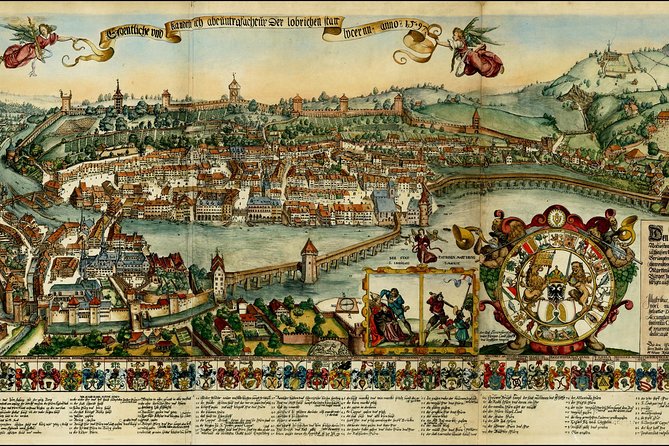
- Martiniplan map (1597) paired with buildings still standing gives you quick spatial understanding
- Chapel Bridge versus the Water Tower lets you compare eras that most people mix up
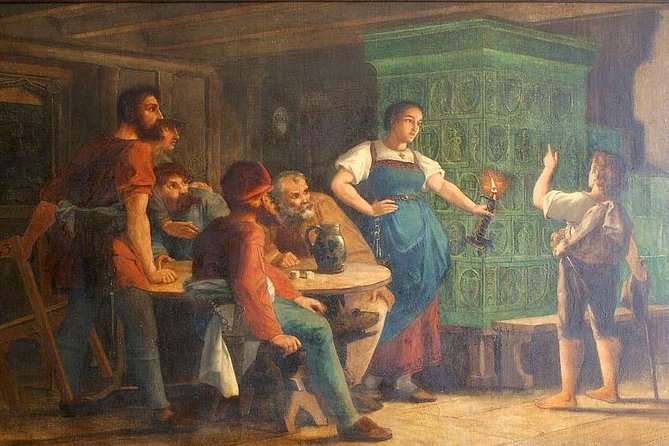
- Folklore in Furrengasse, including the Toggeli, keeps the history human
- Town Square details at Kornmarkt, like the Renaissance town hall and its clock with no minute hand
- Projected “justice” scenes in Zöpfli, plus the Dance of Death imagery later on
- Dark stories, told in a lively way, so you get atmosphere even when it gets heavy
Why a nightwatchman walk works so well in Lucerne
Lucerne at night has the right mood for this kind of tour. Daytime is great, but nighttime adds clarity. Shadows help you notice the old façades, the narrow lanes, and the way the city bends around the river.
This walk is also unusually effective because it is not just standing in front of a monument. You get a guide who tells stories, uses visual projections, and keeps tying facts to street-level clues. That makes the medieval past feel practical, not distant.
More Walking Tours in Lucerne
- Lucerne: Private Walking Tour with a Local Guide
★ 4.6 · 450 reviews - Lucerne Walking & Boat Tour: The Best Swiss Experience
★ 4.5 · 417 reviews - Lucerne: Guided Walking Tour with an Official Guide
★ 4.7 · 321 reviews
Starting at Rosengart Platz: small group pacing and what you actually get
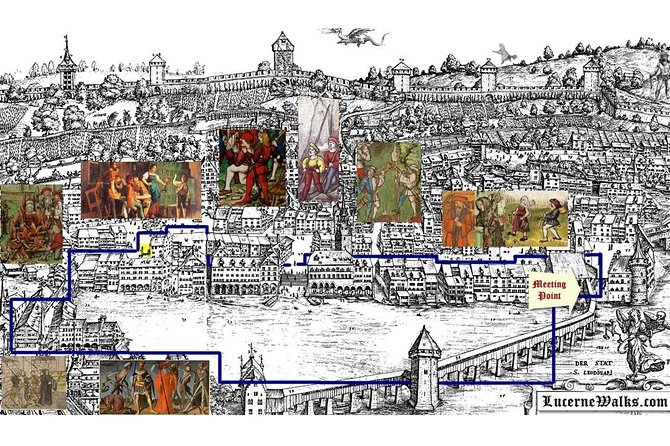
You meet at Rosengart Platz in central Lucerne, and the walk ends right back there. The tour is offered in English and runs in rain, snow, or shine, so dress for the weather and bring an umbrella or rain coat.
A big part of the value is the size. With a maximum of 15 people, you are not swallowed by a crowd. You can hear the guide without leaning like you are trying to eavesdrop on a secret meeting.
You will also use a mobile ticket, and near public transportation means you are not stuck on the edge of town. Service animals are allowed, and the tour is marketed as something most people can join.
Stop 1: Peterskapelle and the Martiniplan map that turns the city into a puzzle
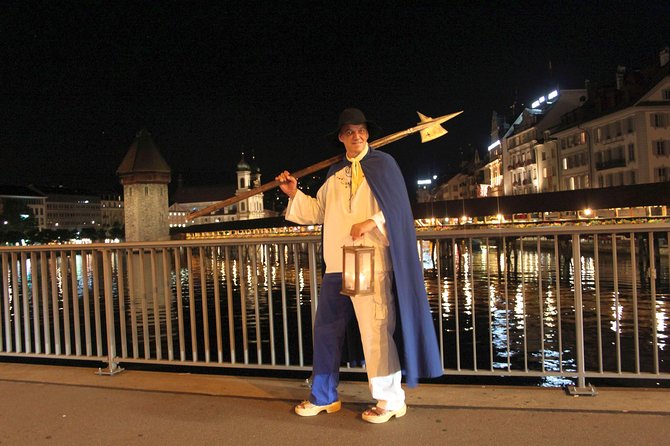
The walk starts at Peterskapelle (Peter’s Chapel). Right away, the vibe shifts into “medieval mode” with a fire-horn style moment and a prayer invocation. Then the Nightwatchman explains what life could be like, and he uses a projector to set up the key idea of the tour: Lucerne’s past is still physically present.
This is where the Martiniplan comes in. You get a detailed look at this early city map, dating from 1597, often described as the first city map of Lucerne. The magic is that you can follow the route on the map and then recognize many of the same buildings in modern Lucerne.
You also see St. Peter’s Chapel, with origins stretching back to the 12th century. Nearby, the guide points out the first private stone house in Lucerne and explains where the expression stone rich comes from. It is the kind of connection that makes you pay attention to material, not just dates.
One practical note: at this stop, admission is marked not included, so if you want to go beyond looking from the outside, you may need to add a ticket yourself.
Stop 2: Chapel Bridge and the Water Tower, built in the “wrong” order
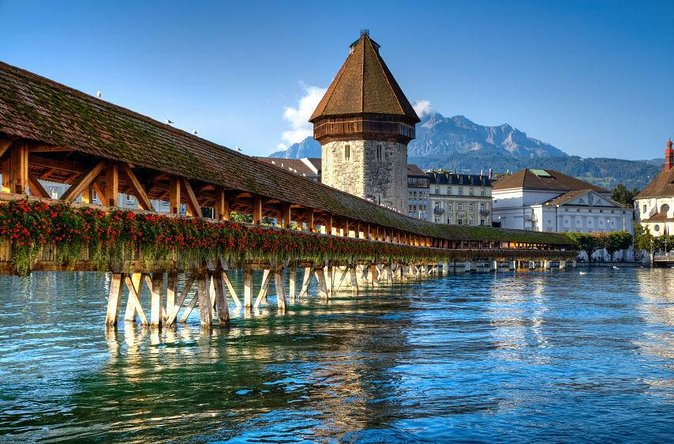
Next you head to Chapel Bridge. The tour flips a common mental model by reminding you that the Water Tower came first, in the late 13th century, while Chapel Bridge dates from 1365.
You also get story details that you usually only hear in lectures, not on a casual walk. The guide shows pictures of the inside of the Water Tower and talks about a torture chamber, a dungeon, and a secret room. Then you learn how Chapel Bridge got its name.
This stop works because it gives you contrasts. People tend to treat Chapel Bridge as one iconic thing. Here, you see it as part of a bigger system of river control, city defense, and law.
A different kind of day out of Lucerne:
- From Zurich: Mount Titlis with Ice Flyer & Lucerne Day Tour
★ 4.7 · 3,899 reviews - Lucerne: Mt. Pilatus Cable Car, Cogwheel Train & Lake Cruise
★ 4.7 · 2,338 reviews - Mount Pilatus Summit from Lucerne With Lake Cruise
★ 4.5 · 1,260 reviews - Lucerne: Round-Trip Catamaran Cruise on Lake Lucerne
★ 4.4 · 1,169 reviews
Stop 3: Furrengasse, Kapellplatz, and the Toggeli folklore detour
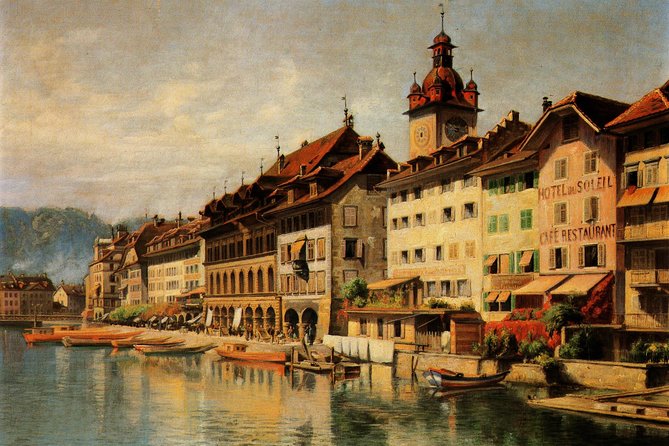
As you turn toward Kapellplatz, you walk through Furrengasse. This is one of the stops where the tour feels like a story collection, not a museum lecture.
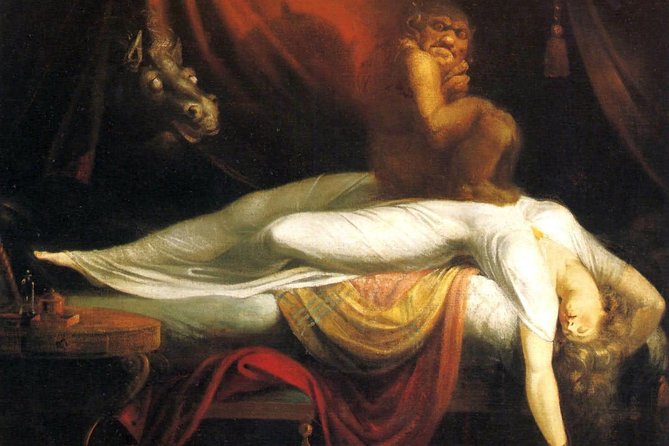
You hear about medieval life in the Republic of Lucerne, then the guide brings in folklore. There is a ghost associated with the area, plus the Toggeli, described as an incubus also called the love robber.
The payoff is not that you learn a random legend. You learn how people explained fear, desire, and wrongdoing before modern categories existed. It makes the city feel like it has memory, not just architecture.
Stop 4: Kornmarkt and the Renaissance town hall details you would miss
At Kornmarkt, you reach the town hall square. This is a strong stop for anyone who likes symbolism on everyday buildings.
You learn about the Renaissance Town Hall and its tower clock, including a very specific detail: the clock has no minute hand. You also hear the story of the Giant of Reiden.
And then you get practical, nerdy, and useful. The tour shows Lucerne Foot and Elle, the official measures of old Lucerne. It is a reminder that the built environment is tied to trade, rules, and daily work, not just ceremonies.
Stop 5: Brandgässli and the riot that lived in the alleys
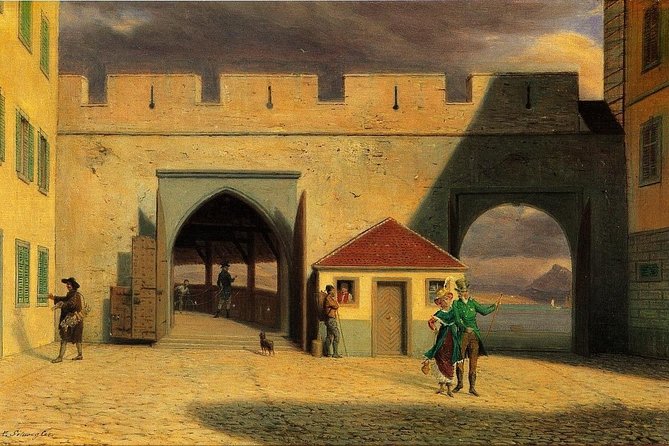
You continue into Brandgässli Alley, where the guide talks about the Riot of Lucerne. Even if riots are not what you thought you signed up for, you get a better sense of how fragile order could be in a medieval city.
Then you move toward the former fish market, which is known today as the wine market. That small pivot, from fish to wine, is exactly the kind of urban continuity you notice more at night because storefronts and façades feel like a set.
Stop 6: Weinmarkt, Latin on house fronts, and a sip of Lucerne’s fountain water
At Weinmarkt, the tour adds layers. You see old guest house signs, and you get to admire frescos on houses.
One standout moment is the story behind a Latin sentence on the former pharmacy house of Renward Cysat: Amor medicabillis nullis herbis, explained as there is no cure for a broken heart. It is funny in a human way, and it signals that medicine and emotion have always been tangled.
The Nightwatchman also talks about Reformation and counter Reformation. That matters because Lucerne was not isolated. These big movements affected politics, belief, and how communities acted.
You then get to enjoy a glass of the best water Lucerne, which is not just a gimmick. It grounds the tour in the everyday, and it is a nice reset before the heavier scenes later.
As you move along, you hear about the pillory’s location in the lower wine market. Again, you are connecting law to architecture, not just telling stories.
Stop 7: Im Zöpfli and the “how punishment worked” projections
At Im Zöpfli, you reach the riverside square. This is the spot where the tour becomes very visual.
The guide describes law and order in old Lucerne, and you see projected paintings about methods of prosecution, interrogation, and corporal punishment. If you are sensitive to grim topics, this is the part to take in slowly.
The reason it is still worth it is that the stories feel specific. You are not hearing generic “people were punished.” You are seeing the mechanics of fear and control, tied to where people stood and what they witnessed.
Along the river you pass the bridge Reussbrücke, then you see Spreuerbruecke (Mill Bridge), the Needle Dam, and parts of the Musegg Wall. Even without a long stop at each, you get that big-city overview of how Lucerne’s defenses and waterways worked together.
Stop 8: Alte Suidtersche Apotheke and the medieval pharmacy window
Next you arrive at Alte Suidtersche Apotheke, described as a breathtaking medieval pharmacy window. This is a calmer stop, even though it is still part of the medieval theme.
The guide tells you more about the house and its location. This works well because it breaks up the heavier justice stories you heard earlier. You see how trade, healing, and the everyday economy shaped what the city looked like.
Admission is marked not included at this stop, so if you want to go in deeper, you should plan on paying separately.
Stop 9: Ritterscher Palace, guardian demons, and the Dance of Death on a wall
At Ritterscher Palace, the tour shifts again into theatrical mode. You hear about guardian demons, then you stop at the legendary house of Lux Ritter.
You learn why the first two floors look different than the third one. Even if you do not know what caused the differences, you start looking with more care. Buildings are not static. They change with owners, wealth, repairs, and politics.
Then comes the story of Hans von Trient, the unlucky stonemason. After that, you reach another major highlight: a presentation of the seven paintings of the Dance of Death. The guide has the imagery projected on a house wall, with details explained as you watch.
This stop is the kind of thing you remember later. The projections do not replace the city, they help you understand why those images were placed where they were.
Admission is marked not included here too, so expect mostly guided viewing, not a guaranteed interior visit.
Passing the Jesuits’ Church and ending the loop back on Chapel Bridge
As you continue, you pass the Church of the Jesuits, described as the first Baroque building in Switzerland dating from 1677. Even though you are only passing it, it is a useful reminder that Lucerne moves forward after the medieval period, and that different styles overlap in the same walk.
Finally, you get back to Chapel Bridge. You cross it and see the paintings while learning why the bridge is built diagonally over the river. At the end of the bridge, you return to the starting point, so you do not have to worry about finding your way back.
Price and value for a $39.54, 1.5-hour English night walk
At $39.54 per person for about 1 hour 30 minutes, this is priced like a guided experience with added “production value.” You pay for the guide in medievally dressed style, the projector visuals, and the guided storytelling that keeps moving.
You also get small extras included, like exclusive post cards featuring Old Lucerne. Those are nice as souvenirs, but the real value is how the guide uses visuals to compress a lot of information into a short route.
One key value check: some stops list admission ticket not included. That means the tour can still be great even if you never pay for an interior visit, but you should expect the option to add tickets if you want more access at Peterskapelle, Alte Suidtersche Apotheke, or Ritterscher Palace.
If you only want an outdoor stroll, it may feel packed because the guide keeps you on a story track. If you want orientation plus color, this is strong value.
Who should book this Nightwatchman walk in Lucerne
This is a good fit if you want a fast way to understand medieval Lucerne without doing a schedule of heavy museums. The walking route hits signature locations like Chapel Bridge and Spreuerbruecke, then fills gaps with map history and building details.
It is also a nice option for art-minded people because you get frescos, Latin text, and the Dance of Death projections in context. Families can enjoy it too, since the tour is framed for a broad range of ages and the guide is often described as funny and personable.
If you strongly dislike dark history, the torture and punishment material might turn you off. The tour does not hide it, even though it is wrapped in a theatrical guide style.
Should you book this Nightwatchman walk?
Yes, if you want medieval Lucerne told with movement, visuals, and very specific details tied to real buildings. It is one of those tours where you finish with clearer mental map lines through the city, not just a pile of dates.
Skip it if you need only light, cheerful sightseeing, since the stories include crime, punishment, riots, and darker subjects. For everyone else, it is a smart, compact way to see Lucerne differently after dark.
FAQ
How long is the Nightwatchman walk in Lucerne?
The tour runs about 1 hour 30 minutes.
Is the tour offered in English?
Yes. The tour is offered in English.
What is the group size?
The tour has a maximum of 15 travelers.
What does the ticket include, and are there any extra admission costs?
It includes a medievally dressed local guide and some exclusive post cards, plus taxes and fees. At certain stops, admissions are marked not included, so you may need to pay separately if you choose to enter those places.
Where do I meet and where does the tour end?
You start at Rosengart Platz, 6004 Luzern, Switzerland, and the tour ends back at the meeting point.
Does the tour run in bad weather?
Yes, it runs rain, snow, or shine, so dress for conditions and bring an umbrella or rain coat.
Recently reviewed around Lucerne
- Best of the Uri Alps: A fjord-like lake, glorious peaks and sustainable tourism★ 5.0 · 3 reviews
- Lucerne 3h Private Photoshoot/videography with a photografer★ 5.0 · 3 reviews
- Walking Tour – Around the Old Town Lucerne★ 3.5 · 3 reviews
- Lucerne Scavenger Hunt and Highlights Self Guided Audio Tour★ 4.5 · 3 reviews
- Lake Interlaken, Day Pass Lake Brienz, 2nd class★ 2.5 · 3 reviews
- Private city tour in lucerne★ 5.0 · 4 reviews
- Historic Lucerne: Exclusive Private Tour with a Local★ 5.0 · 4 reviews
- Beginners Ski Day Trip to Jungfrau Ski Region from Lucerne★ 3.5 · 4 reviews
Walking Tours, compared.
Zurich Walking Tour With Cruise and Aerial Cable Car
Read our review →
Lucerne Walking & Boat Tour: The Best Swiss Experience
Read our review →
3 in 1: Zurich Walking Tour – Cruise on the Lake – Cable Car Ride to Felsenegg
Read our review →Browse the lists this tour appears in