
Reviewed · GENEVA TOURS
Guided Tour of Geneva: Capital of Peace ( Outside )
Geneva’s Capital of Peace tour feels interesting because it turns ideas into real street-level landmarks. You start at Daniel Berset’s monumental sculpture, then you walk through the diplomatic and humanitarian zone where the city’s message of peace is literally built into the view outside.
I particularly love how the guide connects symbols to meaning, especially at the Broken Chair stop, where you get context you would not guess just by looking. One drawback to note: this tour stays outside only, so it does not go into UN buildings or other indoor facilities.
I also like the pacing because you get an actual pause in Ariana Park, with time to look out over Lake Geneva and reset before moving on to the larger institutions. And if your guide is Marie, you get clear explanations with time for photos, not a rushed walk-by.
Key highlights to look for
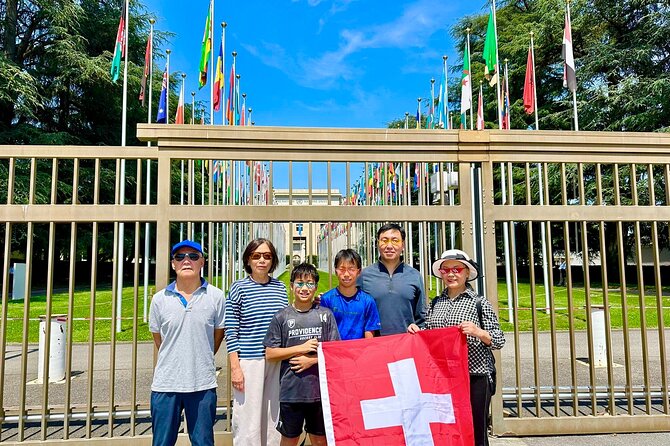
- Daniel Berset’s Broken Chair as a starting point with real historical and artistic context
- Ariana Park for lake views, flowers, and a breather mid-walk
- Palais facades and UN member-state flags to understand what those symbols mean
- The International Committee of the Red Cross area, a humanitarian presence you can read at street level
- Umbrella support if weather turns rainy while you are still outside
- Small-format guided time that works well for first-time Geneva orientation
Why this one-hour Geneva walk makes sense
This is a straight, outdoor introduction to a big part of Geneva’s identity: the place where peace, diplomacy, and humanitarian action show up in public space. Even if you are only in town for a day, you can learn a lot without chaining yourself to a long itinerary or paying for multiple sites.
The structure helps. You get a guided thread through several high-meaning spots, with a guide who explains along the route. That is the difference between looking at buildings and actually understanding why they matter.
Also, it is practical for pacing. The tour is about one hour total, with Ariana Park given around 30 minutes, which is enough time to slow down, take pictures, and still finish on schedule. Geneva can be windy, so having a plan that does not drag on is a plus.
A few more Geneva days worth comparing
- Geneva: 50-Minute Lake Geneva Cruise
★ 4.3 · 4,063 reviews - Award-Winning Geneva Chocolate &Old Town Tour with Boat Ride (3h)
★ 5.0 · 3,721 reviews - Geneva: Scenic Lake Cruise with Snacks and Wine
★ 4.4 · 1,503 reviews
Start at Broken Chair, Geneva’s art with a message
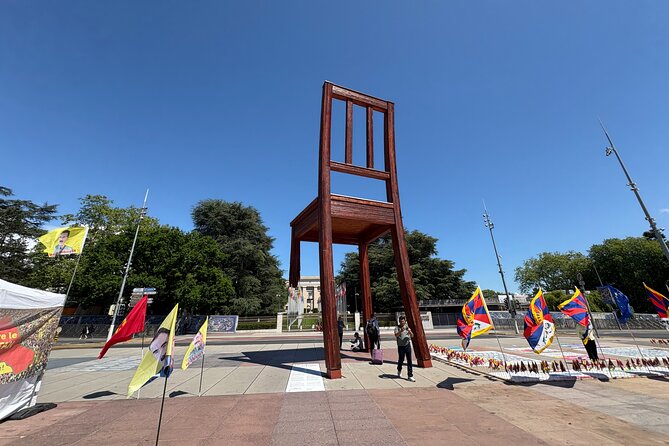
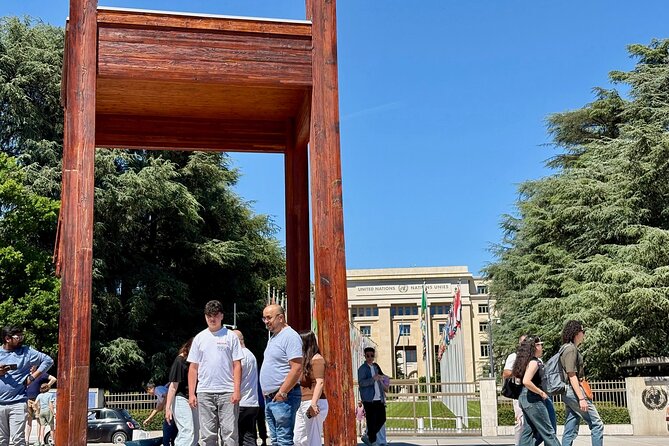
Your tour begins at Broken Chair (1202 Geneva, Switzerland), a monumental wooden sculpture tied to the Swiss artist Daniel Berset and the carpenter Louis Genève. It depicts a giant chair with a broken foot. That detail might sound odd at first, but it gives you a strong visual metaphor for what the city wants to communicate.
What I like about starting here is the immediate clarity. You do not need a museum ticket to begin the story. You just stand there and let the scale hit you, then the guide adds the meaning so it clicks. Public art like this works best when you get the explanation, because otherwise you might only register it as a photo spot.
Practical tip: treat this as your first “slow look.” If you rush to photos, you miss the part where the guide frames what you are seeing. Give it a minute, then snap your pictures.
Ariana Park: the pause with Lake Geneva views
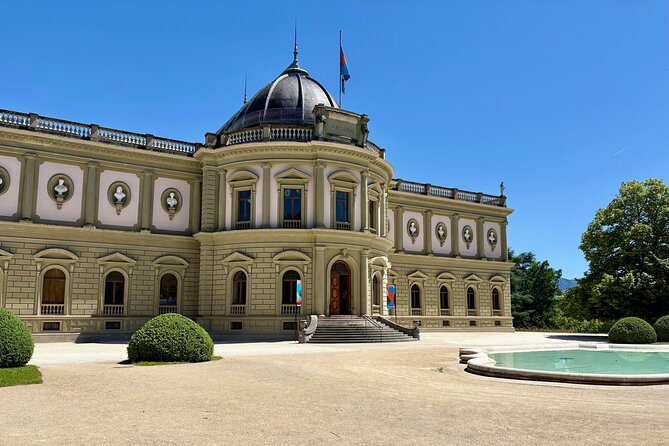
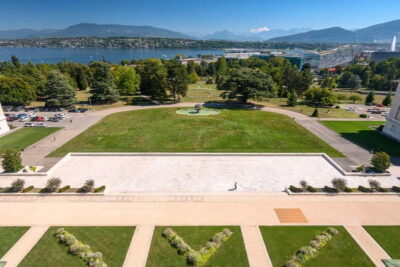
Next up is Ariana Park, a real breath in the middle of a diplomatic walk. The park offers views of the building and Lake Geneva, plus colourful flowers and majestic trees. It is also described as a place for reflection and relaxation, and the guide explains its history and role as a meeting place for cultural and environmental events.
This stop matters because it gives your brain a break from formal facades. It also helps you understand the geography of Geneva, where water, gardens, and institutions all sit close together. In many cities, you have to travel to get a view. Here, the view is part of the route.
If you want a simple strategy for photos, do this: take a couple quick shots of the lake first, then look back toward the buildings. That second direction is where the park framing helps you connect the institutions to their setting.
One consideration: since the tour is outdoors, park time can feel colder or windier if the day is cool. Bring a layer you can add quickly. If rain starts, you are provided an umbrella, which helps you stay moving without that frantic scramble for cover.
The Palace facades and the meaning of UN flags
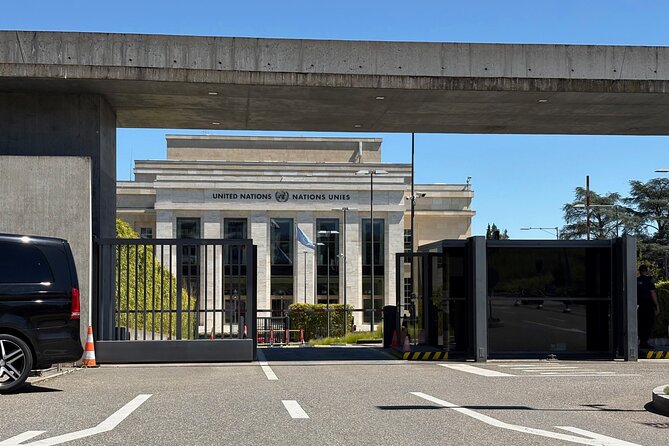
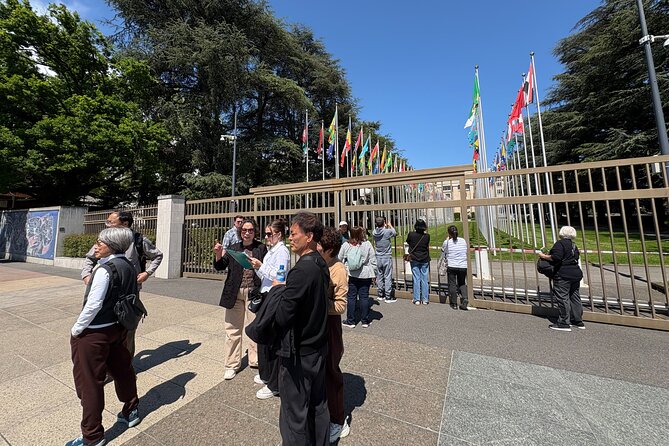
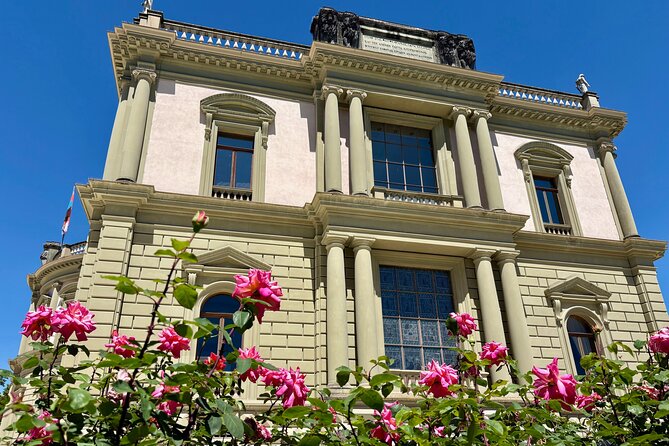
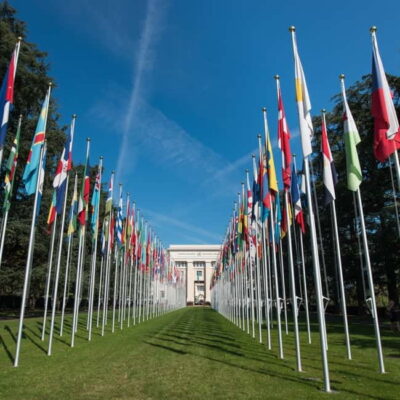
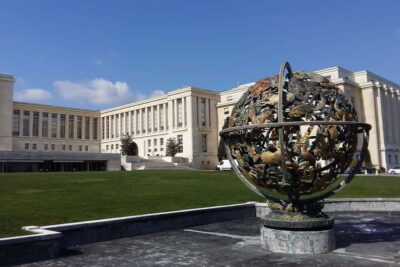
After the park, you observe the imposing facades of the Palace, a neoclassical building. The walk includes its surrounding manicured gardens, where the flags of all Member States are raised. The guide takes time to explain the meaning of those flags and why cultural diversity is important within the United Nations.
This is one of the most valuable parts of the tour because flags are easy to overlook. You might notice them as decoration or background for a picture. But with the guide’s explanation, the flags become a lesson in how international identity works in physical space.
One key detail to plan around: this tour does not go inside the UN. You will be learning from the outside perspective, facades, gardens, and symbol placement. If you came hoping to tour interior halls, this experience will feel like a complementary orientation rather than a full building visit.
Practical tip: when the guide is explaining the flags, lean in just a bit and look for how the garden layout and flag placement guide your eye. It is a small design lesson, and it makes your photos look more intentional afterward.
A different kind of day out of Geneva:
- Chamonix & Mont Blanc Panoramic Sky-Glass Bus Guided Day Trip
★ 4.0 · 1,324 reviews - From Geneva: Annecy Half-Day Trip
★ 4.7 · 1,064 reviews - Geneva: Open-Top Sightseeing Bus Tour
★ 3.7 · 634 reviews - Geneva: Hop-on Hop-Off Bus & Scenic Mini-Train Tour
★ 3.8 · 501 reviews
International Committee of the Red Cross: humanitarian work nearby
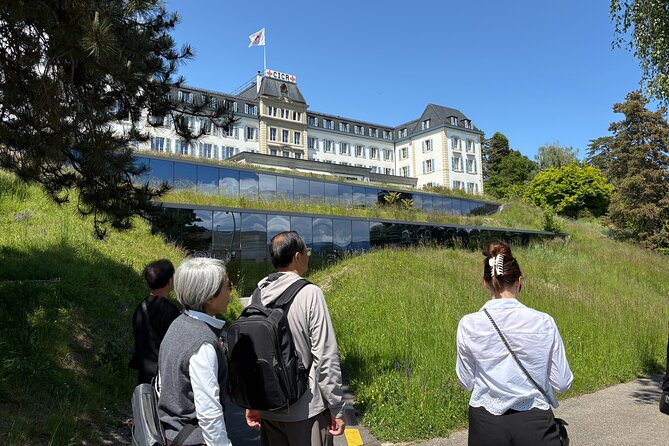
Later, the tour highlights the Geneva-based International Committee of the Red Cross, one of the most respected and recognized humanitarian organizations. You do not need to be a subject-matter expert to appreciate why this stop belongs on a Capital of Peace walk.
What you gain here is context and proximity. Geneva has the kind of reputation you hear about in global news, but street-level recognition is different. Seeing the organization as part of your walk helps make the abstract feel real.
This is also where the outside-only format works in your favor. Instead of trying to do an indoor museum version of humanitarian history, you get a guided explanation that connects the organization to the city’s overall role.
If you like learning with a practical angle, ask your guide to explain what makes the ICRC stand out as an institution in Geneva. You will likely get a clear, no-nonsense answer.
How the route feels in real time (timing, group size, and comfort)
The tour is designed to keep things moving, but not frantic. Duration is about one hour, and the park stop is long enough to feel like an actual break. That matters in Geneva, because the city can involve lots of walking, hills in some areas, and shifting weather.
Group size is set with a maximum of 99 travelers. That is not tiny, so expect the start point to feel busy and the flow to be guided in a coordinated way. Still, with a one-hour outdoor loop, it is usually a manageable size for hearing explanations and taking photos between speaking moments.
Language is English, and a mobile ticket is provided. If you prefer to travel light, this is a simpler setup than printed-only tickets.
Service animals are allowed, and the meeting point is near public transportation. Those details make the tour easier to plug into a day that includes other Geneva sights.
One more practical note: the experience requires good weather. If conditions are poor, you will be offered a different date or a full refund. In other words, the tour is built for outdoors, and you should check the forecast before committing to the day.
What you get included, and what you still need to pay for
This guided tour is not about paid indoor entries. It is about the explanation and the route.
Included:
- A one-hour guided tour with an area guide
- Detailed explanations along the route
- An umbrella if it rains
Not included:
- Entrance tickets
So, if you like tours that keep costs predictable, this works. You are paying for guided context, not admissions. That can be a smart value if you are already planning to visit a few indoor sites separately.
Also, because you stay outside, you avoid the classic trap of spending time in lines. Instead, your time goes into learning, looking, and taking photos.
Value check: is $20.56 per person worth it?
At $20.56 per person, the price is reasonable for a focused, one-hour guided orientation around Geneva’s most symbol-heavy zone. The key value is that you are paying for someone to explain what you are seeing, especially at points like the Broken Chair sculpture and the UN flag setting.
Here is the practical way I think about value:
- If you would otherwise wander alone and only half-understand the meaning behind flags or humanitarian landmarks, the guide helps you get more out of the same physical stops.
- If you only want quick photos, you could probably do a self-walk. But you would miss the interpretive thread that makes these places connect.
- Since entrance tickets are not included, you are not paying for something you cannot use on an outside-only route.
If you enjoy “context walking,” where the city becomes understandable through stories, this is a good buy.
Who this tour is perfect for
This tour fits well if you are:
- Visiting Geneva for the first time and want a guided orientation in a short time window
- Interested in how peace and humanitarian values show up in public space
- Short on energy, time, or daylight, but still want a meaningful experience
- Traveling as a couple, solo, or small group who want structure without committing to a full day
If you want inside access to UN buildings, this is not your match. But as an outside primer, it can set you up to appreciate what you see next.
A few practical tips before you go
- Dress for the outdoors. Geneva weather can shift fast, and this is an outside tour.
- Plan your photo timing. The park stop gives you the best chance to linger.
- Listen during the flag explanation. That part changes how you look at the grounds and buildings.
- If it is rainy, take the umbrella and keep moving. The tour is designed to continue rather than cancel instantly in light rain, though poor weather can cause rescheduling.
Should you book the Guided Tour of Geneva: Capital of Peace (Outside)?
Yes, if you want a short, guided, outside-focused introduction to Geneva’s peace and humanitarian identity. The route makes sense for first-timers, and the time structure is friendly: about an hour, with a real break in Ariana Park.
I would especially recommend it if you like learning from symbols, not just sightseeing. Places like Broken Chair and the UN flag setting are exactly the kind of stops that benefit from a clear guide. And with rain support like an umbrella and a weather-aware plan, it is a low-stress option.
Skip it only if your top priority is interior access to major institutions. This one is built for the outside world, and it does that well.
FAQ
Where does the tour start?
The tour starts at Broken Chair, 1202 Geneva, Switzerland, and it ends back at the same meeting point.
How long is the guided tour?
The tour lasts about 1 hour.
Is the tour inside the UN?
No. This experience stays outside and does not go inside the UN buildings.
What is included in the price?
You get a one-hour guided tour with an area guide, detailed explanations along the route, and an umbrella provided in case of rain.
Do I need an entrance ticket?
Entrance tickets are not included.
What language is the tour offered in?
The tour is offered in English.
Is the tour cancelled if the weather is bad?
The experience requires good weather. If it is canceled due to poor weather, you will be offered a different date or a full refund.
What if it rains?
If rain happens, the provider provides an umbrella.
Is service for people with disabilities and service animals available?
Service animals are allowed, and most travelers can participate.
Can I cancel for a full refund?
Yes. You can cancel up to 24 hours in advance for a full refund. If you cancel less than 24 hours before the start time, you will not be refunded.
Recently reviewed around Geneva
- Geneva to Chamonix Private Transfer★ 5.0 · 7 reviews
- Geneva to Morzine Avoriaz or Les Gets Private Transfer★ 5.0 · 11 reviews
- Private Trip from Geneva to Yvoire and Évian-Les-Bains in France★ 5.0 · 3 reviews
- Geneva: Sightseeing of top Places Tour Electric TukTuk 1H15 tour★ 5.0 · 107 reviews
- Swiss Vineyard Wine Tasting Tour in Vaud★ 5.0 · 5 reviews
- (KTG302) – Day Trip to Montreux & Château de Chillon from Geneva★ 4.5 · 31 reviews
- Vevey, Montreux, Chillon Day Trip from Geneva★ 4.5 · 44 reviews
- Old Town Geneva Private Walking Tour★ 4.5 · 4 reviews
Geneva Tours, compared.
Award-Winning Geneva Chocolate &Old Town Tour with Boat Ride (3h)
Read our review →
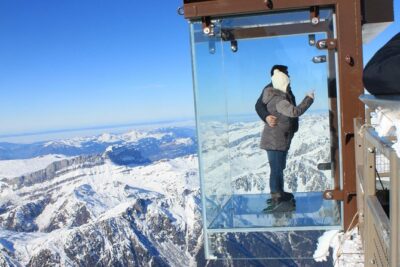
Chamonix & Mont Blanc Panoramic Sky-Glass Bus Guided Day Trip
Read our review →
Best of Geneva City Tour: International Area and Old Town
Read our review →Browse the lists this tour appears in