
Reviewed · WALKING TOURS
Basel Private Walking Tour with a Professional Guide
Basel is one of those cities where the old buildings do not feel like a museum. You walk through real streets and squares, and the architecture tells the story, Romanesque and Gothic side by side with Baroque façades along the Rhine. The experience starts at the Tinguely Fountain, Basel’s main meeting spot, and I like that you get local context right from the first steps.
Two things I especially like: first, you focus on headline sights that are also meaningful, like the Münster Cathedral and Basel’s red Rathaus in Marktplatz. Second, the guide experience seems to matter a lot, with feedback praising guides such as Natalia and Mei for clear, fun explanations. The main drawback to plan for is simple, it’s a walking tour of about 2 hours, so comfortable shoes help, and entrance fees are not included if you want to go inside places that require tickets.
Key Highlights You’ll Actually Notice
- Tinguely Fountain (Fasnachtsbrunnen) as your meeting point, with Jean Tinguely’s theater materials and winter icicle effect
- Elisabethenkirche (Elisabeth Church), Swiss Gothic Revival details from 1857 to 1864 and the Merian sponsorship story
- Münster Cathedral plus the Münster Pfalz viewpoint looking toward Kleinbasel and the Rhine
- Rathaus von Basel at Marktplatz, including the interior patio statue of Munatius Plancus
- Baroque Blue and White House tied to the Sarasin family and what the buildings are used for today
- Middle Bridge (Mittlere Brücke), first inaugurated in 1226, connected to the Gotthard Pass trade route
Starting at the Fasnachtsbrunnen Tinguely Fountain
Most walking tours in Europe begin at a landmark and then race off. This one does the opposite in a good way: you begin at the Tinguely Fountain, known as Fasnachtsbrunnen. It is the main meeting point for citizens of Basel, so you’re grounding your walk in how locals actually orient themselves.
The fountain is also a story generator. It was built by Swiss artist Jean Tinguely using pieces of the old theater that used to be in this spot. In winter, it turns into something visually dramatic, with icicles forming what can look like natural ice sculptures. Even if you visit in warmer months, you’ll still get the sense that public art here is part of Basel’s everyday life, not an add-on.
Practical note: because this is your meeting point, arrive a few minutes early so you can start together and avoid rushing the first explanation.
More Walking Tours in Basel
- Walking Tour through Basel Old Town
★ 4.7 · 1,040 reviews - Basel: Private Walking Tour with a Local
★ 4.4 · 77 reviews - Basel : Private Custom Walking Tour With A Guide (Private Tour)
★ 4.5 · 75 reviews
Elisabethenkirche and Rittergasse: Basel’s Gothic Revival and medieval spine
After the fountain, the walk shifts into a quieter, church-centered stop: Elisabethenkirche, also called Elisabeth Church. In German, you may hear it referred to as Elisabethenkirche or Offene Kirche Elisabethen. It is a Swiss Gothic Revival church built between 1857 and 1864, sponsored by wealthy Basel businessman Christoph Merian and his wife Margarethe Burckhardt-Merian.
What I like is that the story does not stop at the exterior style. The Merian couple is buried in a black marble sarcophagus in the crypt of the church. That kind of detail helps you understand why these buildings were more than just architecture, they were connected to local power, money, and legacy.
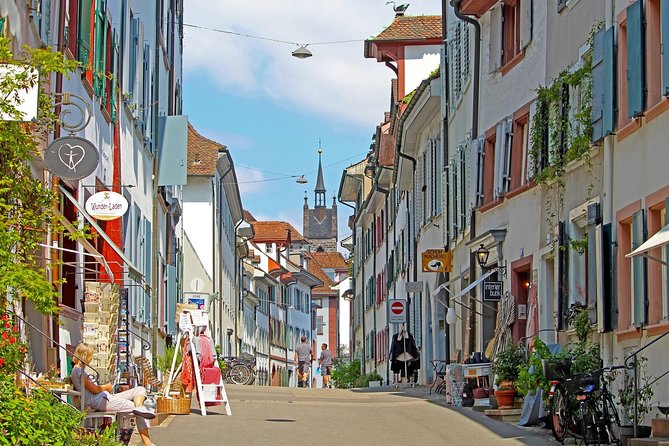
Next comes a medieval move: you walk toward Knights Street, or Rittergasse, which Basel calls the mother of all streets. You’ll see medieval architecture, but more importantly, you’ll get a sense of how the city developed over centuries. This stretch is where the tour does a good job of connecting buildings to time, instead of treating each stop like a separate postcard.
If you’re the type of traveler who enjoys street-level history, this section will feel like your favorite part of the whole tour.
Münster Cathedral and the Münster Pfalz Rhine viewpoint
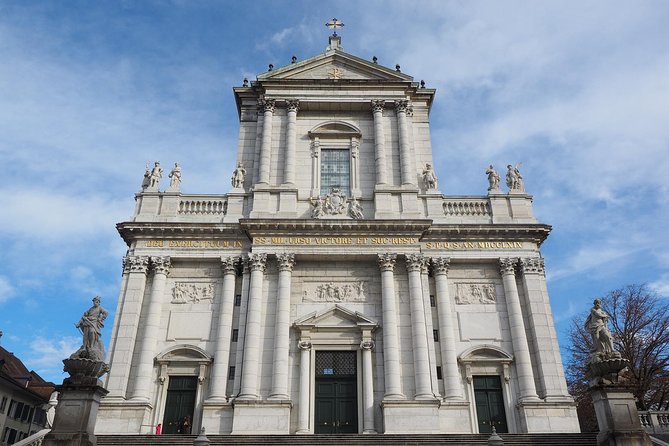
Then you reach Basel’s picture-perfect anchor, Münster Cathedral. This is the big one in the center of the action, and the guide explains why it looks the way it does. You get a mixture of Romanic and Gothic styles, spanning the 12th to 15th centuries. The cathedral is not alone in the frame either, it sits in a large square where events happen, so the setting feels like living public space.
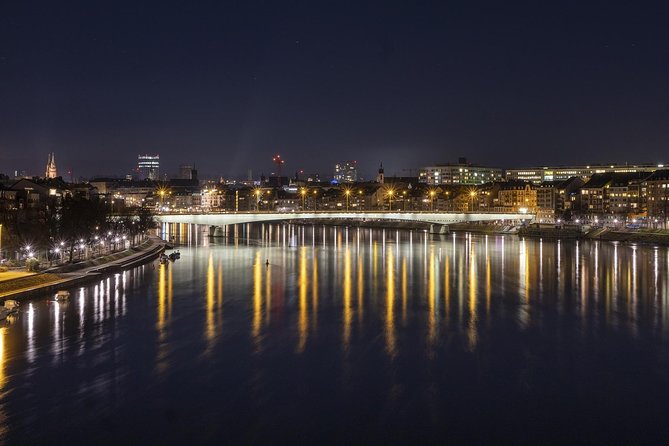
One of the best moments here is not just staring up at stone. It is the transition to views. After the cathedral, you pass by the Münster Pfalz, and you can enjoy a viewpoint toward the city, toward the Rhine, and toward the neighborhood of Kleinbasel. This is where you’ll start to “read” Basel in layers, not as a flat map.
For photos, I’d treat this as your practical checklist:
- Look up first for the style mix.
- Then turn toward the viewpoint for city and river context.
- Try to pause long enough that you can compare what you see around you to what you just heard.
Rathaus von Basel at Marktplatz, plus the Munatius Plancus detail
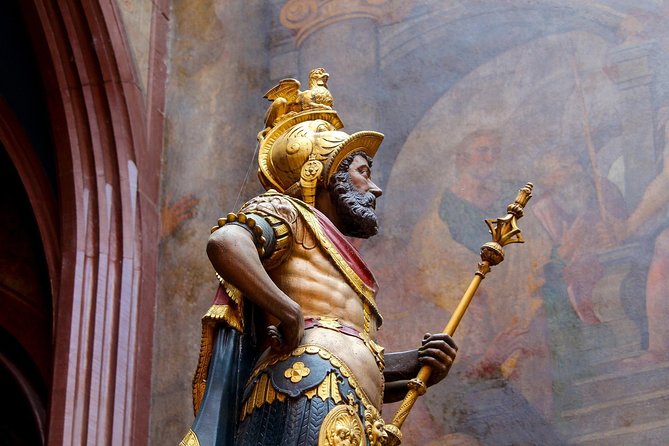
From cathedral scale, you step into civic pride at Rathaus von Basel, the City Hall. It sits in the old market square, Marktplatz, and you’ll spot it quickly because of its red color. The exterior façade is eye-catching, but the standout detail is what you get in the interior courtyard, including a statue of Munatius Plancus, the Roman founder of the city.
This is one of those spots where a good guide changes how you experience it. Without context, Rathaus can look like a pretty building you pass by. With context, you start seeing it as a physical marker of Basel’s identity, from Roman roots to later civic power.
If you’re traveling with someone who thinks “City Hall is boring,” this stop usually fixes that fast, because the story is tied to a name and a timeline, not just decoration.
A different kind of day out of Basel:
- Basel: Sightseeing Bus Tour with Audio Guide
★ 4.1 · 377 reviews - The Best of Basel: Guided Bike Tour
★ 5.0 · 223 reviews - Stories of Basel’s Old Town
★ 4.5 · 203 reviews - Basel Farmer’s Market, Cheese, Chocolate & Pastry Tour
★ 4.5 · 171 reviews
Blue and White House: Sarasin wealth, Samuel Werenfels, and today’s use
Next you move into the elegance of the Blue and White House, also called Blauen und Weisses Haus. These are baroque mansions on the Rheinsprung, built in the 18th century by architect Samuel Werenfels for brothers Lukas and Jakob Sarasin.
Here’s the key connection: the Sarasin descendants went on to found Bank Sarasin & Cie. in Basel. Today, these buildings are used as the seat of the Department for Economy, Social Welfare and Environment. That means you’re not just looking at noble façades, you’re seeing a building continue in public service.
I like that this stop quietly shows a theme you’ll see across the tour. Basel’s important families and institutions are not locked in the past. Their buildings still matter, and they still function.
The Mittlere Brücke and how Basel connects to the Gotthard Pass
No Basel walk feels complete without a bridge moment, and this tour delivers it with the Mittlere Brücke (Middle Bridge). It is one of the oldest monuments in town and was first inaugurated in 1226. Basel’s location on the Rhine made these crossings central, and the tour explains how the bridge connected with the famous Gotthard Pass route.
That connection is more than trivia. It helps you understand why Basel became strategically important. Bridges are infrastructure, sure, but they also shape trade patterns, movement, and the kind of wealth that shows up in city streets and institutions.
If you like practical history, this is the stop where the city’s geography becomes real in your mind.
Barfüsserplatz and the Bare Feet Franciscans, plus where you end
After the bridge area, you head back through the old town, passing Marktplatz again and going toward Barfüsserplatz in the city center. This square matters for two reasons. First, it is one of the most important crossing spots in Basel’s public transportation system. Second, it sits in front of the Barfüsserkirche, the Church of the Bare Feet.
The name comes from the Franciscan order. In German, the Franciscans were known as the Bare Feet because of their vow of poverty. A monastery was built here in 1256, and that’s where the square got its name.
This ending stretch is a good way to transition from guided context to self-guided wandering. The tour can end there, or you can be taken back to the nearby Tinguely Fountain for a more recognizable send-off point, depending on what fits your energy.
Price and value for a private group up to 15 people
The price is $448.58 per group for up to 15 people, for about 2 hours with a local guide. That pricing model can look steep if you’re traveling solo, but it can be a strong value if you have a small group. Since it’s private, your time stays focused on your group, not a large public bus schedule.
Also, you get a mobile ticket, offered in English, and there’s room for possible customizing on the spot with your local guide. That flexibility can matter if you want extra time at the cathedral square, more explanation at Rathaus, or you’d rather keep your pace slower.
Entrance fees are not included. So if you want to go inside any stop that charges separately, you should plan extra budget. On the flip side, not everything on this kind of walking route requires paying in order to get the value. A big part of what you’re buying is the guided interpretation, not just access.
Guide quality: Natalia, Mei, Manley, and Mai in the spotlight
The strongest feedback in the experience centers on the guides. Natalia is praised for commentary that was both awesome and memorable, and there’s a lot of mention of the tour’s cathedral, city hall, and theater area moments.
Mei (spelled also as Mai in one of the notes) is repeatedly described as fun and going above and beyond to make the group enjoy Basel. One review also highlights how the guide used pictures and infographics, which is a practical way to understand why the city looks the way it does. Another review mentions that Mei is bilingual in Mandarin and English, and likely works in Swiss German as well, which is a useful advantage if your group includes more than one language.
And another highlight: Manley is described as outstanding, knowledgeable, and fun. Even without chasing superlatives, what you can take from this is clear. You want a guide who can explain architecture without turning it into a lecture, and you want a guide who can keep the group engaged while walking.
That matters because Basel’s beauty is partly visual, and partly interpretive. A guide helps you connect those two.
Who this Basel private walking tour suits best
I’d think of this tour as ideal for you if you:
- Want a tight 2-hour route through Basel’s key old-town sites
- Like architecture explanations, especially where styles overlap from different centuries
- Prefer a private group so the pace can match your comfort level
- Want Rhine and bridge viewpoints without needing extra logistics
It might be less ideal if you:
- Hate walking on city streets for any length of time
- Expect lots of paid interior attractions, since entrance fees are not included and the experience is mainly based on the walking route and outdoor context
The good news is that most travelers can participate, and it is near public transportation, so you can fit it into a busy Basel itinerary without a major commute.
Quick planning tips before you go
- Wear comfortable shoes, because old Basel streets and squares mean you’ll be on your feet for the full loop.
- Bring a phone for the mobile ticket, and for quick photo comparisons when the guide points out style differences.
- If you’re sensitive to weather, Basel’s seasons can change quickly. Winters can be especially relevant because the fountain’s icicle look is tied to that season.
Should you book this Basel private walking tour?
If you want Basel in one guided loop that hits cathedral, city hall, baroque mansions, and Rhine viewpoints, I think this is a good choice. The pricing makes most sense for small groups, and the guide focus is strong, with named guides like Natalia and Mei standing out for clear, fun storytelling supported by visuals.
Book it if you like walking with context. Skip it if you’re looking for a long museum-style day, or if you want only major interior entrances.
FAQ
How long is the Basel Private Walking Tour?
The tour lasts about 2 hours.
How big is the group for this private tour?
It is a private tour for your group only, with a group size up to 15 people.
What language is the tour offered in?
The tour is offered in English.
Where do we meet for the tour?
You meet at Tinguely-Brunnen, Klostergasse 7, 4051 Basel, Switzerland.
What is included in the price?
A local guide is included, along with the private guided tour. The tour also mentions possible customizing on the spot.
Are entrance fees included?
No. Entrance fees are not included.
Is there a mobile ticket?
Yes, the tour includes a mobile ticket.
Recently reviewed around Basel
- From Basel: Jungfraujoch Top of Europe and Lauterbrunnen Private★ 5.0 · 4 reviews
- From Basel: Mount Säntis, St. Gallen Old Town & UNESCO Library★ 5.0 · 4 reviews
- Traditional Swiss Dinner: Cheese Fondue, Appetizers/Dessert★ 5.0 · 5 reviews
- Alsace’s Villages, Colmar and Castle Private Car Tour for 1-6★ 5.0 · 5 reviews
- Basel City Tour: The Essentials★ 5.0 · 8 reviews
- Chocolate Making Workshop, Bean to Bar Experience | From Basel★ 4.0 · 9 reviews
- Basel’s Portrait: Self-Guided Reading City Tour★ 3.9 · 15 reviews
- Basel: Self-Guided Food Tour★ 4.3 · 68 reviews
Walking Tours, compared.

Zurich Walking Tour With Cruise and Aerial Cable Car
Read our review →

Lucerne Walking & Boat Tour: The Best Swiss Experience
Read our review →
3 in 1: Zurich Walking Tour – Cruise on the Lake – Cable Car Ride to Felsenegg
Read our review →Browse the lists this tour appears in